
Language

How to organize your Pokémon TCG binder by Pokédex (guide with placeholders)

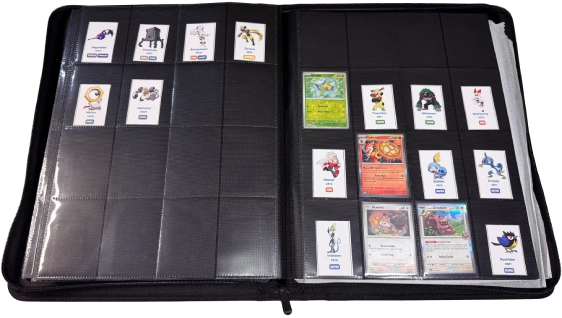
Set up your binder in Pokédex order, leave slots with placeholders: complete first, improve later.

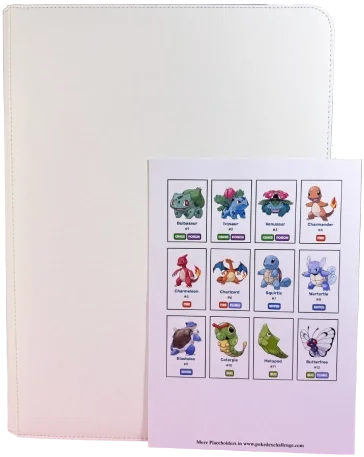
Visual guide to start organizing the Pokédex binder

Checklist before you start

Before placing anything, make sure you have the basics. It saves you from redoing pages, cutting twice and ending up with split generations.

Great Ball icon

Highly recommended ⭐

  1. Variants binder

    Regional, megas, gigantamax, etc. Better separate to avoid breaking the main flow.

    Recommended binders for variants
  2. Card sleeves

    When you replace a placeholder with a real card, sleeve it first and then put it in the binder. Protects more and avoids friction.

  3. Paper cutter (guillotine or roller)

    Straight cuts, much faster and looks more pro.

    Paper cutter recommendations
Ultra Ball icon

If you want to go all in (optional) 🚀

  1. Jumbo binder (promos/large cards)

    They don't fit in normal binders: Jumbo or XXL cards go separately, without bending or getting in the way. Sooner or later you'll get XXL cards, so it's best to have the binder ready.

    See binders for Jumbo cards

Once you have this, the next step is deciding the exact order, whether to leave gaps and which variants to include. That detail prevents redoing pages.

Recommended order by generations

Make your binder a physical Pokédex: clear, stable, and without “where do I put this now?”.

Base Pokédex

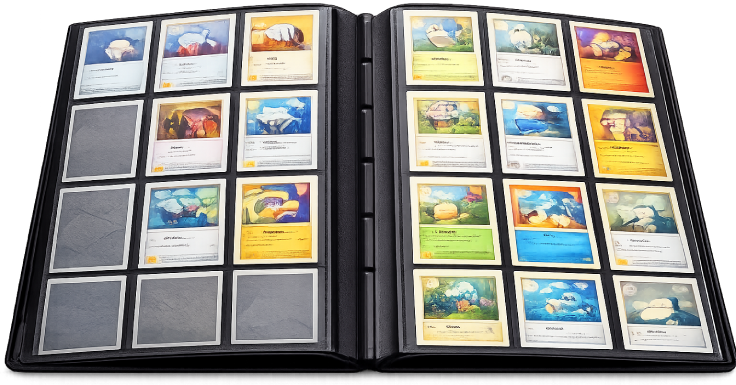
Recommended Pokédex binder

In the main binder.

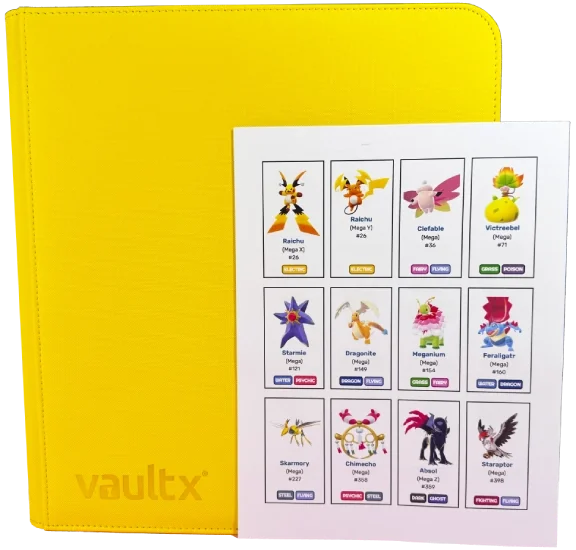
Variants in a second binder

Recommended variants binder

Or at the end of the main binder if you have space, but keep in mind new generations or forms may force you to move it.

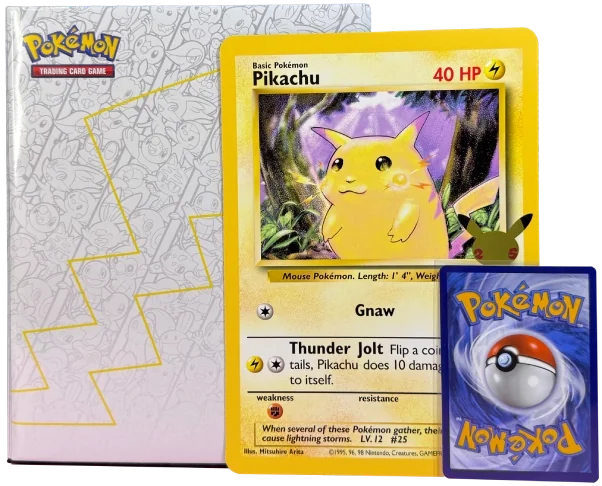
Jumbo/XXL in a separate third binder

Jumbo card binder

Always separate, to keep them controlled and out of the way. A place to store XXL cards and prevent damage.

Why this way? Order that lasts

Separating by binder keeps the Pokédex clear and avoids reshuffling pages when new forms appear.

  • You keep main progress crystal‑clear

    (what you’re really completing).
  • You prevent forms/variants from breaking order

    and forcing you to rearrange half the binder.
  • It keeps the collection alive

    you can upgrade without messing up anything.

Which forms/variants go in and which should be separated?

Master Ball icon

Golden rule: if a variant breaks the order or forces you to rearrange half the binder, separate it.

Quick example icon

Quick example

Animated Raichu
  1. 1

    You place the Pokémon TCG placeholders in order and reach Raichu. You continue with Sandshrew, the next in the Pokédex.

  2. 2

    Sun/Moon releases and Alolan Raichu appears. To add it to the main binder, you’d have to shift everything to make room.

  3. 3

    Then Mega Raichu X and Mega Raichu Y appear. If you were placing megas next to the Pokémon, you'd have to reorder again.

Solution: Main binder (Pokédex) + Variants binder

The variants binder includes

Animated Porygon

You decide the detail level: this binder is for "extra". Use it if you want finer progress without touching Pokédex order.

Galarian Ponyta

Regional forms

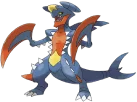
Mega Garchomp

Mega evolutions

Gigantamax Snorlax

Gigantamax / Dynamax

Terastalized Terapagos

Other special mechanics

But... what about form changes—how do I order them?

You might ask, but we have Pokémon that don't fit these conditions:

Dancing Ditto

Pokémon with multiple forms

  • Deoxys forma normalDeoxys: Normal, Attack, Defense, Speed.
  • Wormadam forma plantaWormadam: Plant, Sandy, Trash.
  • Giratina forma origenGiratina: Altered Form, Origin Form.
  • Shaymin forma cieloShaymin: Land, Sky.
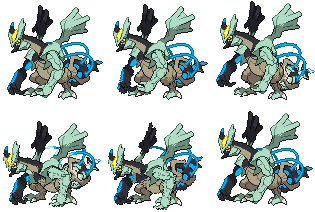
  • Kyurem forma negroKyurem: Black Kyurem (fusion of Kyurem + Zekrom) and White Kyurem (fusion of Kyurem + Reshiram).
  • Rotom forma lavadoRotom: Base, Heat (oven), Wash (washer), Frost (fridge), Fan, Mow (lawn mower).

And many more...

Frillish spriteOgerpon spriteMeowstic sprite
Animated Alakazam

How to act smartly

  1. Identify: These are forms that don’t have a specific Pokédex number, are not tied to a region (regional forms), and don’t have an associated mechanic (mega, terastalization...).
  2. Reason: You can think of them as forms tied to the Pokémon’s original release; it’s unlikely new forms will be added years later. This rarely changes.
  3. Consider: Check if there is a representative card that covers all forms, so you don't need one card per form (e.g., Unown or Squawkabilly).
  4. Decide: For these forms, the best is to use your judgment and prioritize consistency.

Should I leave blank sheets between generations?

Yes. It’s your safety margin: maybe tomorrow you decide to add that Shaymin form you skipped, recover a placeholder you didn’t place, or a new Rotom form appears.

If you're tight on capacity

When the binder is almost full, leave only the necessary margin.

Leave 1 blank row. It gives flexibility without losing Pokédex slots.

Example of a blank row as margin

If you have plenty of room

If you have extra space, use it to protect against future changes and additions.

Leave nearly a full blank page. More room for new forms or tweaks without redoing the binder.

Example of a nearly full blank page

How to place placeholders (without going crazy)

Once you have them printed and cut, the key is placing them without bending and without fighting the binder.

See how it’s done

  1. 1Insert the placeholder only halfway into the slot (don't push it all the way).
  2. 2Use a dummy card (common/duplicate) as a pusher: push gently and straight until the placeholder sits correctly.
  3. 3Repeat with the rest.
Speed Forme Deoxys

Tip to go faster

Insert all placeholders for two binder pages halfway. Then finish them one by one with the dummy card.

Here is a step‑by‑step demo of placing placeholders in a binder without effort.

Everything placed—now what?

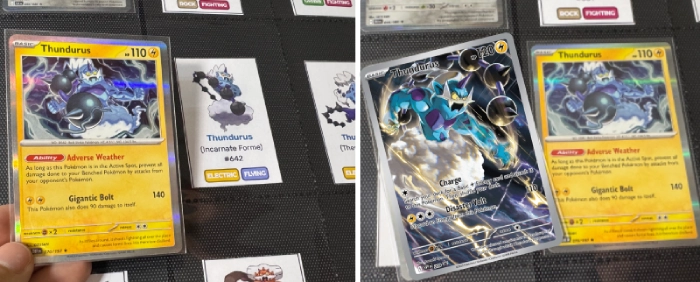
Replace (the fun part)

  • Every time you get a Pokémon card, remove the placeholder and insert the card.
  • If later you get a better version, upgrade and done.
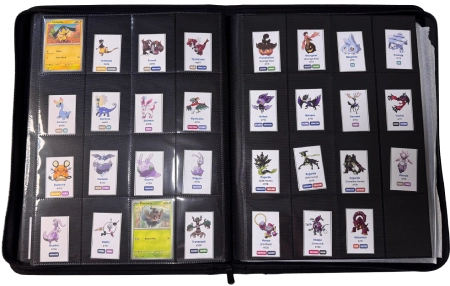
Example binder with placeholders in order

Tips

  • Remove the placeholder before inserting the card: it avoids bending and forcing the binder.
  • Always sleeve the cards and then place them in the binder (much more protection).
  • When you upgrade, you can reuse the same sleeve and move it to the higher‑rarity card.

FAQ when organizing the binder

Can I do the Pokédex in Spanish/English/Japanese/Korean?

Yes. English usually has more variety but can be more expensive/variable in stock; other languages are often easier to start with. The important part: keep the method consistent. You can also build a mixed Pokédex with multiple languages.

What about Unown forms?

Unown has cards for letters and symbols, so you can choose your level:

  • Completionist mode: 1 card per letter/symbol.
  • Simple mode: 1 representative Unown card and done.
  • Mixed mode: a few letters + a special card you like.

What about Spinda forms?

Spinda doesn't have one card per form—it would be impossible with 4,294,967,296 patterns. For the challenge, the best is to choose the Spinda card you like most and ignore patterns.

What should I do with megas, regional and other variants?

The cleanest approach is to keep them in a variants binder (or a separate section) so you don't break the main order.